
Bill of sale or receipt: which one actually proves what
Sell a laptop to a stranger from a listing site and the question comes up fast: does this need a receipt, or something more? The two documents look similar enough at a glance, a payer, an amount, a date, that it is easy to reach for whichever one is already open.
They are not interchangeable. A receipt is proof of payment. A bill of sale is proof of a transfer of ownership, on stated terms, and it is doing a different job entirely.
What each document actually proves
A receipt is short by design: who paid, how much, when, what it was for, and how they paid. That is the whole job. It confirms money changed hands. It says nothing about who owned the item before the payment, whether it was theirs to sell, or what condition it was in.
A bill of sale does more. Alongside the seller, buyer and price, it describes the item precisely enough that it cannot be confused with another one, has the seller certify they actually own it and that it is free of liens, and states plainly whether the sale is as-is or comes with some assurance about condition. It is the document that answers "prove you actually bought this" months later, which a receipt was never built to do.
When a receipt is enough
Most payments never need more than a receipt: a service you paid for, a deposit, rent, a routine purchase where nobody is ever going to ask who owned the item before you bought it because it came from a shop, not a private seller. A receipt is also the right document on the other side of a statement of work or an invoice: the invoice asks for the money, the receipt confirms it arrived.
When you need a bill of sale instead
The test is resale value and disputability. Selling something a stranger might later claim was stolen, damaged before the sale, or never really yours to sell, calls for a document that nails down the item and the terms, not just the money. Furniture, electronics, equipment, anything sold privately for real money: a general bill of sale covers it.
A vehicle is the clearest case, and gets its own version: the vehicle bill of sale adds the VIN, an odometer reading, and the same as-is language, because a car is exactly the kind of asset that gets disputed later, over mileage, over a mechanical fault, over who actually sold it. The paperwork for selling a car privately covers where this sits alongside the title transfer itself, which is the document that legally moves ownership; the bill of sale is the record of the sale, not the transfer mechanism.
The as-is clause, and why it is worth reading
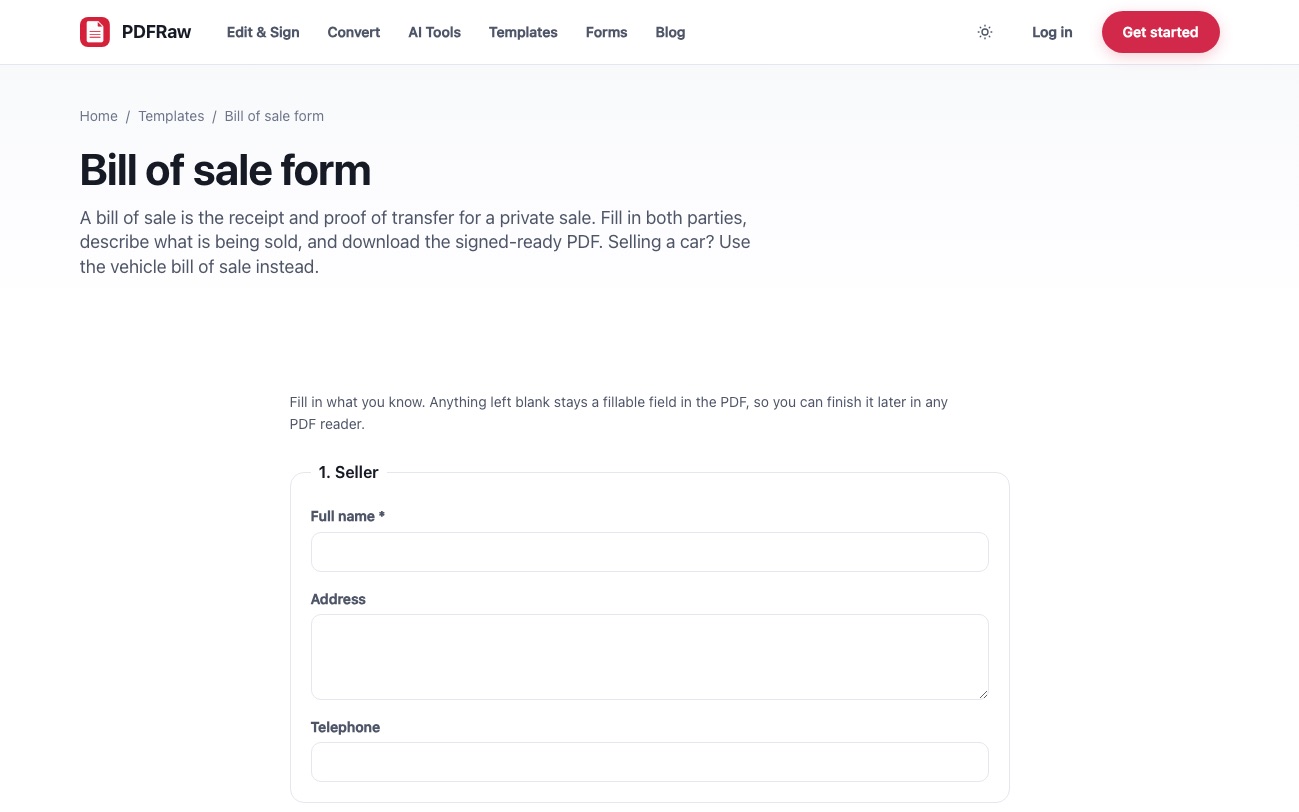
Both PDFRaw bill of sale templates carry an as-is checkbox: tick it and the buyer accepts the item in its present condition, with the seller making no promise about condition or fitness for any purpose beyond what is written into the description. Leave it unticked and add notes instead if you are actually offering some assurance, a returns window, a stated defect you are standing behind.
A receipt has no equivalent, because a receipt was never making a claim about condition in the first place. This is the clearest sign of which document you actually need: if the condition of the thing sold matters enough to write down, a bill of sale is doing work a receipt cannot.
Using both together
Nothing stops a seller issuing both: a bill of sale as the record of what was sold and on what terms, and a receipt as a short confirmation the buyer can carry separately for their own records, an expense claim, or a warranty registration. For a private sale of any size, the bill of sale is the document worth keeping; the receipt is the convenience on top.
Whichever you fill in, both are ordinary PDFRaw templates: fill in the browser, download the finished PDF, no watermark, no account. Neither one needs a notary, though a bill of sale for something the buyer will retitle, a vehicle again being the example, should still be signed the way the buyer's state expects so it holds up when they go to register it.
Frequently asked questions
Is a bill of sale the same as a receipt?
No. A receipt proves a payment happened. A bill of sale proves an item changed ownership, describes the item precisely, and states the terms of sale, including whether it was sold as-is.
Do I need a bill of sale to sell a used car privately?
Yes, alongside the title transfer, which is the document that legally moves ownership. The vehicle bill of sale is the record of the sale itself: parties, VIN, odometer reading and price.
Can a receipt work as proof of ownership?
Not reliably. A receipt confirms a payment, not that the seller actually owned the item or that it is free of any prior claim. A bill of sale is built to answer that question; a receipt is not.
What does selling something as-is mean?
The buyer accepts the item in its present condition, and the seller makes no promise about its condition or fitness for any purpose beyond what is written in the description. Both PDFRaw bill of sale templates make this an explicit checkbox rather than an assumption.
Do I need both a bill of sale and a receipt for the same sale?
Not usually, but there is no harm in it: the bill of sale is the substantive record, and a short receipt on top gives the buyer something simple to keep for their own records.
Does a bill of sale need to be notarized?
It depends what happens next with the item. For a private sale between two individuals it is usually enough signed in ink; a vehicle the buyer needs to retitle should be signed however that state's DMV expects, which is not always a notary.