Invoice vs receipt vs quote: which document to send, and when
Freelancers and small businesses run on three documents, and mixing them up costs real money: an invoice sent when a quote was expected reads as presumptuous, and a missing receipt turns into an awkward email thread at tax time.
The distinction is simply time. Before the work: quote. After the work: invoice. After the money: receipt. This guide walks through what each one commits you to, what belongs on it, and where to get a fillable template for each.
The quote: a price before the work
A quote answers "what will this cost?" in writing, before any work starts. Once a client accepts it, it generally becomes the basis of your agreement, so the number should be one you can live with.
A quote that protects both sides includes:
- An itemised breakdown of the work, so "website" does not silently include "and also hosting forever".
- A validity period. Costs change; "valid for 30 days" keeps an old number from binding you in six months.
- What is excluded, stated plainly. The absence of this line is where scope creep is born.
- Payment terms you intend to invoice under, so nothing on the invoice is a surprise.
The free quote template has these fields laid out. Fill it in the browser and download a clean PDF. For larger projects where the work itself needs defining, a statement of work does the heavier lifting.
The invoice: a request for payment
An invoice says: the work is done, or the milestone reached, and payment is now due. It is a legal document with tax consequences, which is why numbering and dates matter more here than anywhere else.
Every invoice needs:
- A unique, sequential invoice number. Tax authorities notice gaps and duplicates.
- Your business details and the client's, including tax or VAT numbers where they apply.
- Line items matching the accepted quote, because differences between quote and invoice are how disputes start.
- The issue date, the due date, and the payment terms in plain words: "Net 14", "due on receipt".
- How to pay you. Every missing bank detail is a day added to the payment delay.
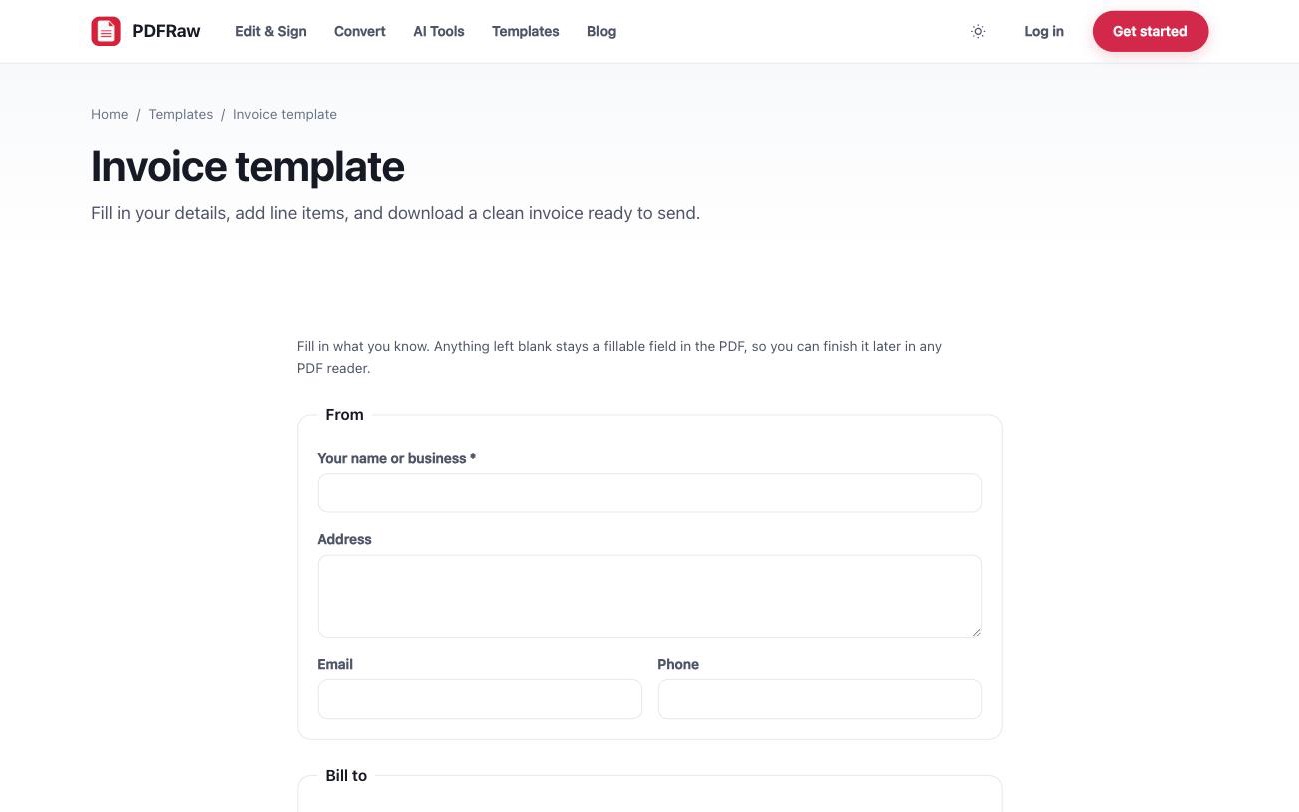
The free invoice template covers all of it, stays editable for the next invoice, and downloads without a watermark. Send the PDF, not the editable file, and consider adding your signature where clients expect one.
The receipt: proof the payment happened
A receipt closes the loop: money arrived, here is the record. Clients need it for their books, expense claims and tax filings, and issuing one unprompted is the kind of small professionalism people remember.
Keep it simple: what was paid, when, how, by whom, against which invoice number. The free receipt template is exactly that. An invoice marked "PAID" is not quite the same thing; it asserts payment rather than recording how and when it arrived, and some accounting departments will bounce it back. Selling a physical item privately rather than billing for work is a different case again; bill of sale vs receipt covers when the receipt stops being enough.
How the three fit together
One job, three documents, in order:
- Client asks the price. You send a quote and they accept it in writing.
- You do the work. On completion, or at the agreed milestone, you send an invoice whose line items match the quote.
- Payment arrives. You send a receipt referencing the invoice number, and file all three together.
That last verb, file, deserves the ten seconds it takes. Keeping the trio together per job means tax season is retrieval rather than reconstruction. Merge the three PDFs into one file per job, or per client per month, and the paper trail keeps itself.
The rest of the paperwork shelf
The same fill-in-the-browser templates exist for the documents that orbit these three:
- Timesheet, when billing is hourly and the invoice needs backing.
- Expense report, for costs you re-bill or reclaim.
- Statement of work, when a quote is too thin to define the project.
- Meeting minutes, for decisions that would otherwise be remembered three different ways.
The library goes further than the paperwork most people ever open; templates you did not know PDFRaw had tours the rest, from project status reports to a travel itinerary.
Frequently asked questions
Is a quote legally binding?
An accepted quote generally forms the basis of a contract, which is why quotes carry validity periods and exclusions. An estimate, by contrast, is a non-binding approximation. Label the document as what it is.
Can an invoice serve as a receipt?
Not reliably. An invoice requests payment; a receipt records that payment arrived, when, and how. Some accounting departments and tax offices insist on the distinction, so it is safer to issue both.
Do I need special software to make these documents?
No. The templates fill in your browser and download as clean PDFs, free, without a watermark or an account. The fields stay editable so next month's invoice starts from this month's.
What numbering should invoices use?
Sequential and unique is the rule. A simple scheme like 2026-001, 2026-002 works, keeps tax authorities content, and quietly tells clients neither "you are my first customer" nor nothing at all.
Should I send these documents as PDFs?
Yes. A PDF renders identically everywhere and is awkward to edit accidentally, which is what you want for documents with numbers on them. Keep the editable version for yourself; send the PDF.