Selling a car privately: the paperwork that actually matters

Selling a car to a stranger for cash is one of the larger private transactions most people ever make, and it usually happens in a driveway in about twenty minutes. The paperwork is what stands between that and a phone call six weeks later about parking tickets on a car you no longer own.
This guide covers the four documents involved, why each one exists, what to check before you hand over the keys, and where the rules change depending on your state.
The title is the transfer, everything else supports it
One point clears up most of the confusion: for a titled vehicle, ownership moves through the certificate of title, not through the bill of sale. The seller assigns the title to the buyer, the buyer takes it to the state and applies for a new title in their name. No amount of signed paperwork on the side changes who owns the car if the title was never assigned.
That is also where the deadlines live, and they are shorter than people expect. Texas requires the vehicle to be titled in the buyer's name within 30 days of the sale, filed at the county tax office with Form 130-U. Florida gives the buyer 30 days to apply for a title, with a late fee after that under state law. Alabama requires the buyer to obtain a license plate within 20 calendar days of acquiring the vehicle.
Before you list the car, find the title and read it. If it is missing, if a lien is still recorded on it, or if the name on it is not exactly yours, sort that out first. Every one of those takes longer than the sale itself, and discovering it with a buyer standing in front of you holding cash is the worst possible moment.
What the bill of sale is actually for
If the title does the transferring, why bother with a bill of sale? Because the title records ownership and nothing else. It does not say what was paid, when, on what terms, or in what condition the car was handed over. The bill of sale is the record of the transaction itself.
It matters in three situations that are common enough to plan for. A buyer who comes back a month later claiming the car was sold as roadworthy. A tax office asking what the vehicle actually sold for. A dispute about the date, which decides who was responsible for the car when something happened.
A vehicle bill of sale that does the job records the seller and buyer, the vehicle by year, make, model and VIN, the odometer reading, the price and date, whether the sale is as-is, and any liens or known defects. The as-is clause is the one people skip and later wish they had not: it states that the buyer accepts the vehicle in its present condition with no warranty, express or implied.
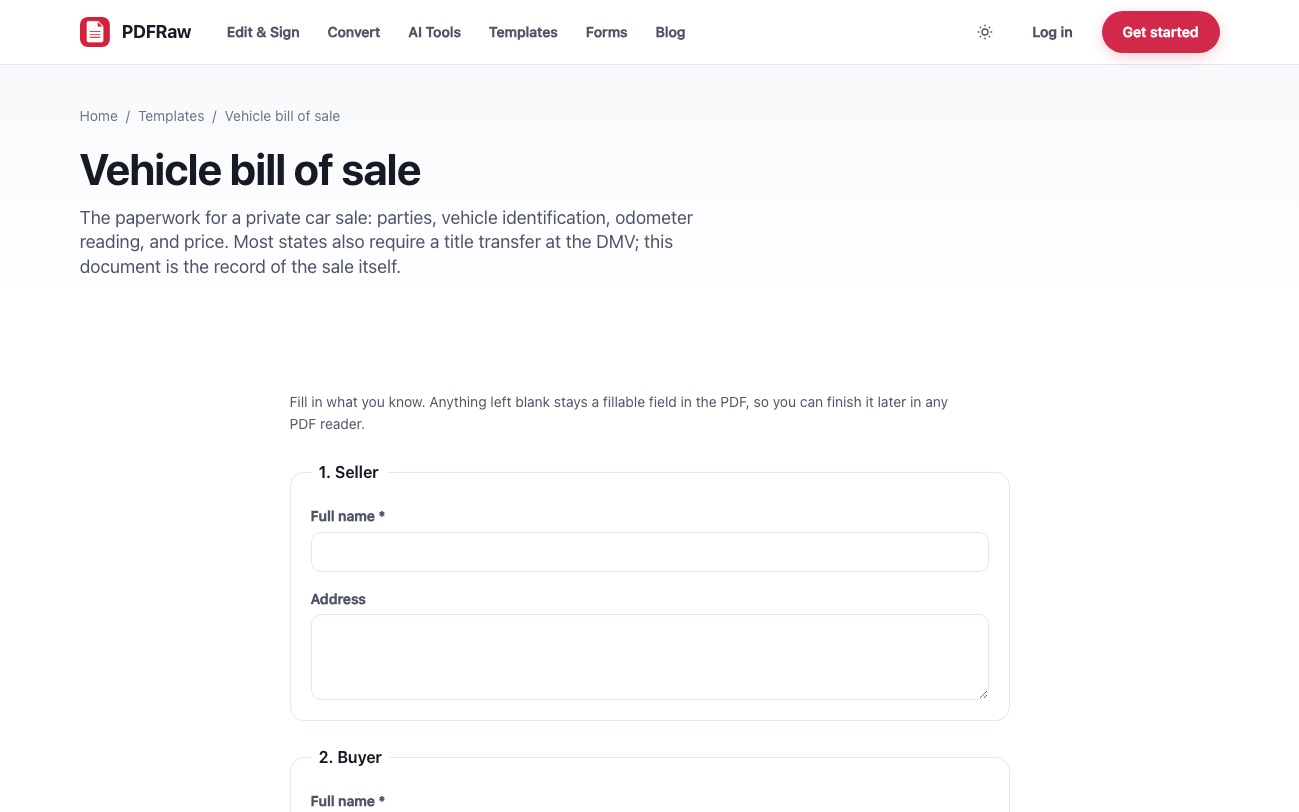
For anything other than a vehicle, a boat trailer, a piece of equipment, furniture, the general bill of sale covers the same ground without the vehicle specific fields. Print two copies whichever you use, because both parties need one, and the buyer will often be asked for theirs at the title office.
The odometer disclosure is not optional
Federal law requires the seller to state the mileage on transfer of ownership for most vehicles, and this is the entry people are casual about at exactly the wrong time. Write the reading as it appears, to the mile, and do not round it.
If the reading is not the actual mileage, because the odometer was replaced, broken, or has rolled past its mechanical limit, say so on the form. There are boxes for both cases. Recording a figure you know to be wrong without flagging it is the part that turns a mistake into a serious problem.
In many states the disclosure belongs on the title assignment itself rather than on a separate document. Texas is one: the odometer reading goes on the title, so a buyer should check the seller completed it before driving away. Where a state publishes a combined form, such as Florida's HSMV 82050, the disclosure is built into it.
Tell the state you sold it
This is the step that protects the seller, and it is the one most often skipped because the money is already in hand and the car is already gone. Until your state knows the vehicle changed hands, its records still show you as the owner, and tickets, tolls and worse follow the registered owner.
- California asks the seller to submit a Notice of Transfer and Release of Liability to the DMV within 5 days of the sale.
- Texas sellers file a Vehicle Transfer Notification with TxDMV. Filed within 30 days, it means the seller cannot be held responsible for parking tickets and toll violations run up by the buyer.
- Florida's combined form, HSMV 82050, doubles as a notice of sale and is filed with the local tax collector office.
Most states have some version of this, under a name of their own. File it the same day. It usually takes a few minutes online and it is the only part of the process that exists purely for your benefit.
Plates are the other loose end, and states split on it. In some the plates stay with the seller and come off before the car leaves; in others they transfer with the vehicle. Check yours rather than guessing, because driving away on plates that should have been removed causes problems for both sides.
Where your state changes the answer
Almost every question in a private sale has a state specific answer. Whether a bill of sale is required at all, whether it must be notarized, whether the state publishes its own form, which office handles the title, and how long the buyer has to file it.
Some patterns hold across most states. Notarization is generally not required for a private party vehicle bill of sale, though a handful of states do require it and county practice varies. State DMVs commonly do not list a bill of sale among the strictly required title documents when a properly assigned title exists, which is exactly why the document is for your protection rather than the state's.
We keep a page of researched requirements for each state, including California, Texas, Florida, New York, Ohio and Georgia, each pointing at the official state source. Read yours before the buyer arrives.
The checklist for the day
- Have the title in hand, in your name, with any lien released. Do not start without it.
- Fill in the bill of sale in advance with everything except price, date and signatures, so the driveway conversation is short.
- Take payment in a form that clears. Cash, or a bank transfer you have watched arrive. A cashier's cheque handed to you on a Sunday is a promise, not a payment.
- Sign the title over to the buyer, complete the odometer entry, and sign the bill of sale. Both parties keep a copy.
- Remove the plates if your state requires it, and hand over one set of keys, the spare, and the service records.
- File the release of liability or transfer notification with your state the same day.
If the buyer is paying over time rather than all at once, that is a different transaction and needs a promissory note alongside the bill of sale, setting out the amount, the schedule and what happens on a missed payment; promissory note, loan agreement or IOU covers the decisions behind it. Handing over the title before you have been paid in full is a decision to make deliberately, not by accident.
To sign the PDF electronically rather than printing it, the Sign PDF tool adds a signature to the file, and how to sign a PDF online covers when that is accepted. For anything the state will see, expect to bring paper. And if the buyer wants a straightforward payment receipt as well, the receipt template handles that in a minute, though bill of sale vs receipt explains why the receipt is the extra, not the substitute.
Frequently asked questions
Do I need a bill of sale to sell a car privately?
In many states it is not strictly required for the title transfer when a properly assigned title exists, but it is the only record of price, date, condition and as-is terms. Some states publish their own form and some county offices ask for supporting purchase documents, so having one is the safer default.
Does a vehicle bill of sale need to be notarized?
Usually not. Most state motor vehicle agencies do not list notarization as a requirement for a private party bill of sale, though a small number of states do require it and local practice varies. Check your state page before you sign.
What does selling a car as-is actually mean?
It means the buyer accepts the vehicle in its present condition and the seller gives no warranty, express or implied, about it. State it in writing in the bill of sale, and note any known defects rather than leaving them unsaid.
What happens if I do not report the sale to my state?
The vehicle stays registered to you in state records, so tickets, tolls and other liabilities can still be directed at you. Filing the release of liability or transfer notification, often within a few days of the sale, is what ends that exposure.
Who keeps the license plates?
It depends on the state. In some the plates stay with the seller and are removed before the vehicle leaves; in others they transfer with the car. Confirm with your state motor vehicle agency rather than assuming.
Is the vehicle bill of sale form free?
Yes. Fill it in the browser, download the PDF, and print a copy for each party. No watermark and no account required.