
How to set up a power of attorney, decision by decision

A power of attorney is one of those documents people put off because it sounds like a lawyer sized project, then need urgently at the worst possible moment. It is actually a short document. What takes thought is not the paperwork, it is the four decisions behind it.
This guide walks through those decisions in order, then covers the part that decides whether the finished document works at all: signing it correctly where you live. Rules genuinely differ from state to state, and a bank that will not accept your document is the failure mode to design against.
What a power of attorney actually does
A power of attorney lets one person, the agent, act on behalf of another, the principal, in the areas the document names. Signing one does not take anything away from you. You keep every power you had, and you can revoke it while you have capacity. It simply adds a second person who can act.
Two limits are worth knowing up front. A financial power of attorney ends at death, so it does not distribute anything or replace a will. And it is separate from a health care directive, which covers medical decisions and is a different document in most states.
The everyday use is more ordinary than the drama implies: paying bills while someone is in hospital, handling a house sale from another country, managing a parent's accounts as their memory fades. It is a practical tool, and its value is that it exists before it is needed.
Decision one: who your agent is
This is the whole document. Everything else is detail. Your agent will be able to move money, sign on your behalf, and deal with institutions in your name, often at a point where you cannot supervise what they do.
Three qualities matter more than closeness of relationship: trustworthiness with money, the organisation to keep records, and the willingness to be firm with a bank that is being difficult. The most beloved person in your family is not automatically the right choice, and picking the eldest child by default is how families end up in trouble.
Name a successor agent as well. People decline, move away, fall ill, or die first, and a power of attorney with no living agent is just paper. The successor costs you one extra line now and saves a court application later.
Then tell them. An agent who discovers their appointment in a crisis is starting from behind, and one who does not know where the document lives cannot use it.
Decision two: which powers to grant
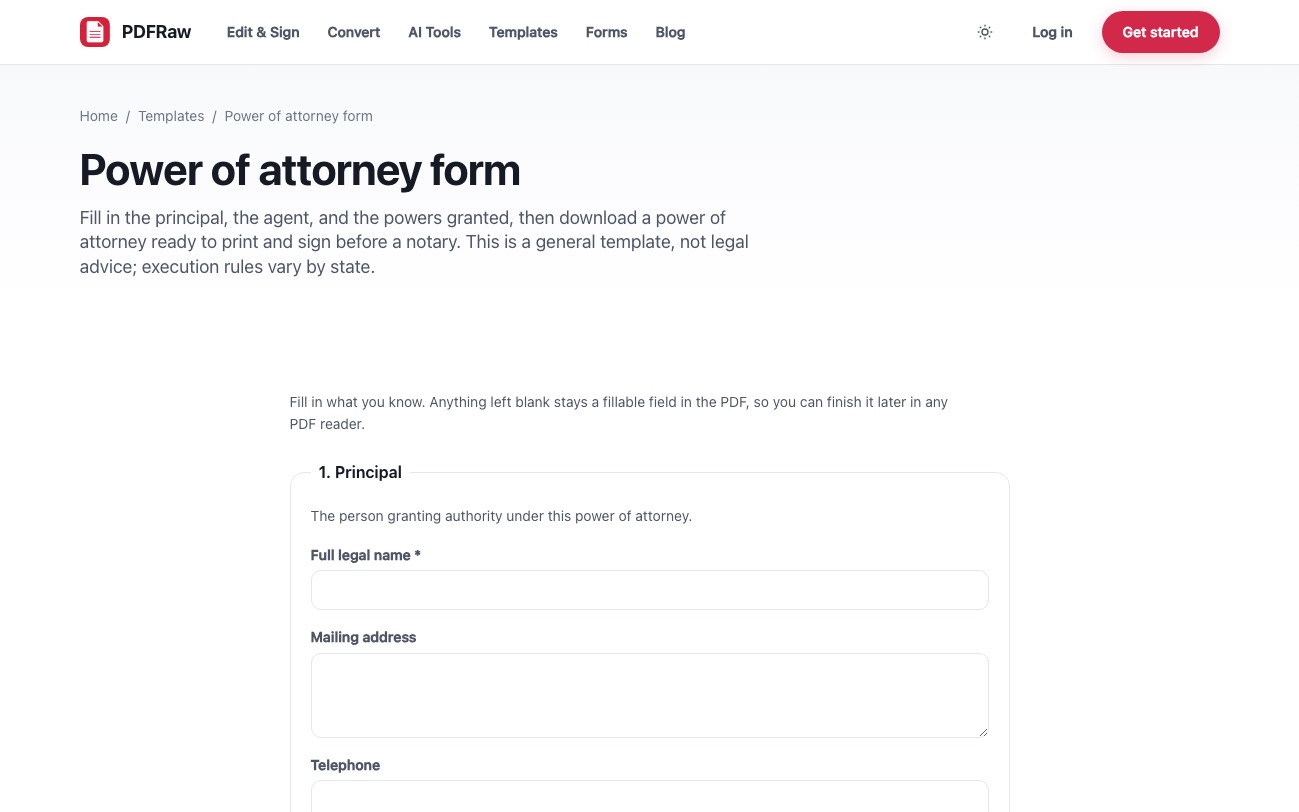
You are not obliged to hand over everything. The powers are itemised so you can grant exactly what the situation calls for, and the list on the form covers the usual categories:
- Banking and financial accounts, the one almost every power of attorney includes.
- Real property transactions, which is what a house sale needs.
- Personal property transactions.
- Tax matters, including dealing with revenue authorities on your behalf.
- Government benefits.
- Retirement accounts.
- Business operations, if you run one that must keep running without you.
- Insurance and annuities.
- Claims and litigation.
There is a real tension here. A narrow grant is safer but tends to be useless at the moment it is needed, because the one thing that has to be done is the thing you did not tick. A broad grant works but demands more trust. Most people who are choosing someone they genuinely trust grant broadly and manage the risk through the choice of agent rather than by shrinking the list.
If the document exists for one specific job, a house closing you cannot attend, say, grant only what that job needs and add a note in the special instructions section describing it.
Decision three: durable, and when it starts
Durable means the authority survives your incapacity. This is the point of the document for most people, because incapacity is precisely when someone needs to act for you. A power of attorney that stops working when you become unable to make decisions has stopped working at the only moment it mattered.
Whether durability is automatic depends on your state, and this is one of the sharpest differences between them. In states that adopted the Uniform Power of Attorney Act, durability is generally the default and the document has to say so if you want it to end at incapacity. California is not one of those states: under its Probate Code, durability requires express language saying the authority is not affected by later incapacity, and without those words the authority may lapse.
The other half of the question is when the authority begins. Immediately on signing is the common answer, and the practical one, because institutions understand it. The alternative, a springing power that starts only on a defined event such as a doctor certifying incapacity, sounds safer but introduces a second problem: someone must prove the event happened before the bank will act, and that proof can take weeks.
Decision four: signing it the way your state requires
Here is where a good document becomes a useless one. Execution rules are set by state law, and they differ in ways that are not intuitive.
- Some states require acknowledgment before a notary public. Some accept witnesses instead. California accepts either a notary acknowledgment or at least two qualified witnesses under its Probate Code.
- Some states require both a notary and witnesses, and the number of witnesses varies.
- Some states do not strictly require notarization at all, but a notarized signature carries a presumption of genuineness, and banks expect it regardless. Alabama works this way.
- If the document will be used for real estate, it usually has to be notarized so it can be recorded, whatever the general rule says.
The pattern across all of it: notarize. Even where the statute does not demand it, the notary is what makes the document usable at a bank, a title company, or a county office. It is an hour of your day and it removes the most common reason a power of attorney gets refused.
We keep a page of execution requirements for each state, researched against official state sources, including Texas, Florida, New York, Illinois and Pennsylvania. Read yours before you sign, not after. Outside the US, the equivalent document works differently: the UK's lasting power of attorney has to be registered with the Office of the Public Guardian before an attorney can use it at all, which government forms beyond the IRS covers alongside the rest of PDFRaw's non-US forms.
After you sign it
A signed power of attorney sitting in a drawer that nobody can find is close to no power of attorney at all. Three things make it work in practice.
- Give your agent an original or a certified copy, and tell your successor agent where the document is kept.
- Take a copy to the institutions that will need it, particularly banks. Some ask you to register it or to complete their own internal form, and finding that out now beats finding it out in an emergency.
- If real estate is involved, ask the county recorder where the property sits what they require, because recording rules are local.
Revoking is your right while you have capacity. Do it in writing, retrieve the copies you handed out, and tell every institution that has one on file, because a bank holding an old copy has no way of knowing it was revoked.
To sign and share the document electronically, the Sign PDF tool adds your signature to the PDF, and how to sign a PDF online covers where electronic signatures are accepted. For a power of attorney specifically, treat the notarized paper original as the real document, because that is the version an institution will ask to see; typed, drawn, uploaded or notarized covers why this document in particular needs ink and a notary while most everyday paperwork does not.
One last thing worth saying plainly: this is a general guide and a general form, not legal advice. Large estates, a family business, property in more than one state, or any expectation of a dispute are all reasons to have a lawyer in your state look at it. For a straightforward arrangement between people who trust each other, the form and your state's execution rules are usually the whole job. And if part of what your agent will be handling is money you have lent or borrowed, promissory note, loan agreement or IOU covers getting that debt into writing too.
Frequently asked questions
Does a power of attorney need to be notarized?
It depends on the state. Some require a notary acknowledgment, some accept witnesses instead, and some require both. Even where notarization is optional, banks and county offices usually expect it, so notarizing is the practical default everywhere.
What is the difference between a durable and a general power of attorney?
Durable means the authority continues after the principal loses capacity. In states following the Uniform Power of Attorney Act durability is generally the default; in others, California among them, the document must say so expressly.
Can my agent change my will or make medical decisions?
No. A financial power of attorney does not allow an agent to make or change a will, and medical decisions belong to a health care directive or medical power of attorney, which is a separate document in most states.
When does a power of attorney end?
On revocation by the principal while they have capacity, on a date or event stated in the document, or at the principal's death. A non durable power of attorney also ends if the principal becomes incapacitated.
Can I name two agents together?
Many states allow co-agents, but requiring both to agree can stall urgent decisions and some institutions handle it badly. Naming one agent plus a successor is simpler and is what most straightforward arrangements use.
Is the power of attorney form free?
Yes. Fill it in the browser, download the PDF, and print it for signing. No watermark and no account required, and the state pages set out the execution requirements where you live.
Related articles

Promissory note, loan agreement or IOU: what to put in writing when you lend money

How to fill out government forms online, without a printer

How to sign a PDF online without printing it

Typed, drawn, uploaded or notarized: which signature actually holds up