Promissory note, loan agreement or IOU: what to put in writing when you lend money
Someone you know needs money, you have it, and you would like both the friendship and the money to survive the experience. The instinct to "keep it informal" is exactly backwards. Informal is what turns a loan into a disagreement about whether it was a loan at all, let alone when it was due.
The fix is a short document, and the only real question is which one. This guide explains what an IOU, a promissory note and a loan agreement each actually do, the handful of decisions to make before you write one, and what to do with the paper once it is signed.
What each document actually is
The three names get used interchangeably, and they are not interchangeable. They sit on a scale from "evidence that money is owed" to "a full contract", and the right one depends on how much is at stake and how much could go wrong.
- An IOU records that one person owes another a sum. That is usually all it records. No interest, no due date, no consequences for not paying. It is better than nothing, and not by much.
- A promissory note is a written, signed promise by the borrower to repay a specific amount to a specific person, with the interest rate, the repayment schedule, what counts as default and what happens then. Only the borrower has to sign it, because only the borrower is promising anything.
- A loan agreement is a contract between both parties. Alongside the repayment terms it carries conditions: what the money may be used for, collateral, what each side represents to the other, what the lender may do if a condition is broken. Both sign. For anything secured or sizeable, the lender will often want this, with a promissory note attached as the actual promise to pay.
For a personal loan, a loan to a family member, or a loan into a small business you trust, the promissory note is the document that earns its keep. It takes ten minutes, it states every term that could later be disputed, and it is what a court expects to see. The promissory note template is built around exactly that: parties, terms, repayment, default, signatures.
Decide these before you write anything
A note is only as good as the decisions behind it, and the blanks on the page are a checklist of those decisions. Settle each one out loud with the other person before either of you signs.
- The principal. The amount actually handed over, on the date it was handed over. Not the amount you discussed in March; the amount that left your account.
- Interest, if any. A private lender may charge interest, but every state caps the rate under its usury laws, and a rate above the cap can make the interest or the whole note unenforceable. Check your state's limit before you fill the box. Zero interest is allowed, and between family members it is common; it can carry tax consequences on larger loans, which the tax section below covers.
- How it gets repaid. A single payment on a fixed date, or installments of a stated amount at a stated frequency with a final maturity date. Pick one and write the dates down. "When you can" is not a schedule and is the single most common reason these arrangements sour.
- What a missed payment means. A grace period in days, a late fee, and the lender's right to call the whole balance due if a default is not cured after written notice. Deciding this in advance is not an insult to the borrower; it is what lets a late payment be handled by the document rather than by a row.
- Prepayment. Whether the borrower can pay early without penalty. The template says yes, which is the friendly default and the one most private lenders want.
- Governing law. The state whose law applies, usually the state where the lender lives or the money changed hands.
If the money is secured by something, a car, equipment, a share of a property, that is the point where a plain promissory note stops being enough on its own. The note can still record the debt, but securing it properly is a matter of state law and, for vehicles and real property, of title paperwork; see the paperwork for selling a car privately for how a car changes hands on paper, and talk to a lawyer for anything larger.
What the note says, section by section
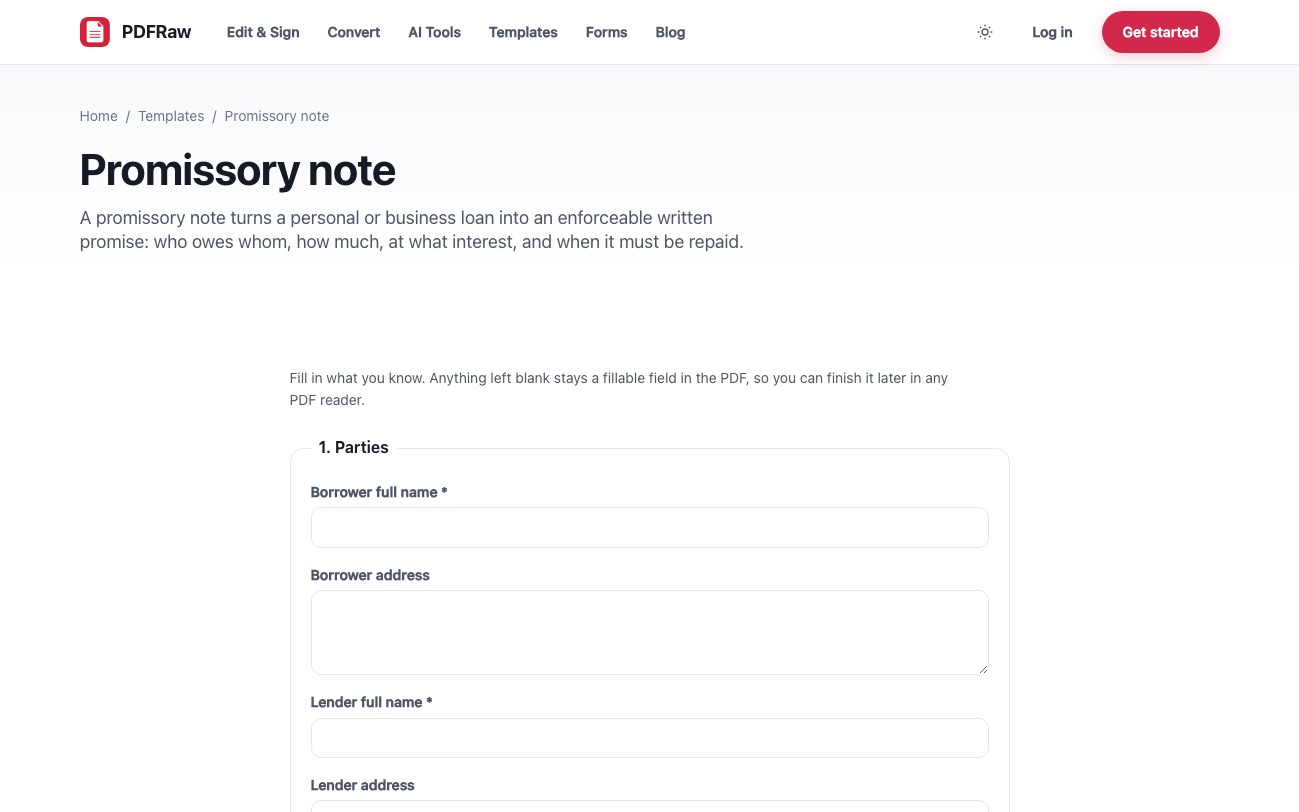
The template is five short sections, and each one exists to close a specific argument before it can start.
- Parties. Full legal names and addresses of the borrower and the lender. Nicknames and first names do not identify anyone to a court.
- Loan terms. The principal, the annual interest rate on the unpaid balance, and the date of the loan. This is where the usury check applies.
- Repayment. A checkbox for single payment or installments, with the matching dates, amounts, frequency and final maturity date.
- Late payment and default. Grace period, late fee, acceleration after written notice, prepayment without penalty, and the borrower's waiver of presentment and notice of dishonor, which is the standard clause that means the lender does not have to perform a formal demand ritual before treating the note as defaulted.
- Signatures. The place of signing and the borrower's signature, with an optional line for the lender.
Two things the template deliberately does not do. It is not legal advice, and it does not pretend to be a different form in each state: the document is general purpose, and for a significant sum or a complicated situation the right move is to have a lawyer read the finished PDF. That costs far less than a dispute.
Signing it, and who keeps what
The borrower signs; the lender may. The template's own guidance is to sign in ink after printing, because some uses of a note call for witnesses or a notary, and the rules on that differ by state. A notarized note is not required in most ordinary cases, but notarization makes the signature very hard to dispute later, which is the whole reason you are writing the note down.
For an everyday loan between two people who would both rather not print anything, a typed or drawn electronic signature is binding for ordinary agreements in the US and the EU; how to sign a PDF online explains the legal footing, and the Sign PDF tool places one on the finished note. If there is any chance the note ends up in front of a bank or a court, ink and a notary are the conservative choice.
Then the custody rule, which matters more than people expect: the lender keeps the signed original until the loan is repaid, and then returns it to the borrower marked paid in full. Holding the original is how the lender proves the debt; getting it back marked paid is how the borrower proves it is over. Each side should also keep a copy. If you share the copy by email, password protecting the PDF keeps a signed document from being casually edited in transit.
As payments come in, record them. A receipt for each payment, or a running schedule both sides can see, means the final "paid in full" is a formality rather than an argument about whether March was paid.
The tax side, briefly
Interest a private lender receives is income, and goes on the lender's return; once interest and dividends together pass $1,500 in a year they are itemized on Schedule B. A bank issues a 1099-INT for interest it pays; a friend repaying a personal loan generally does not, which does not make the interest any less reportable.
Charging no interest, or very little, on a family loan above a modest size can have consequences of its own, because the IRS can treat the interest you did not charge as if you had and then given it away. The same goes for forgiving the loan: a debt you decide not to collect is a gift, and gifts above the annual exclusion are reported on Form 709. Neither is a reason to avoid lending to family; both are reasons to put the interest rate and the schedule in writing and, for larger amounts, to ask a tax professional before you set the rate to zero.
The 1099-C, which reports cancelled debt of $600 or more, is filed by lenders whose trade or business is lending. A private individual forgiving a personal loan does not file one; the gift rules above are what apply instead.
When a note is not the right document at all
Some arrangements feel like loans and are not, and putting them on a promissory note muddles them. A few that come up:
- You are buying something and paying over time. That is a sale with deferred payment. The sale needs a bill of sale or, for a car, a vehicle bill of sale, and the deferred payment is where the promissory note comes in alongside it, not instead of it.
- You are putting money into someone's business for a share of it. That is an investment, not a loan, and needs an agreement that says what you own. A note would make you a creditor, which is a different position entirely.
- A deposit on a rental. A security deposit is not a loan to the landlord; it is governed by the lease and by state deposit rules.
- Someone will be managing your money for you. That is a power of attorney, and how to set up a power of attorney walks through the decisions behind it.
- A large, secured or business loan with conditions. Use a loan agreement, written or reviewed by a lawyer, with the promissory note attached as the promise to pay.
Everything above lives in the PDF templates library, filled in the browser and downloaded as a PDF with no account and no watermark. If you end up with a note, a bill of sale and a receipt for the same transaction, merging them into one PDF keeps the record together.
Frequently asked questions
Is a promissory note legally binding?
Yes, when it is signed by the borrower and states the essential terms: who owes whom, how much, and when it is due. It is the standard evidence of a debt. Execution formalities such as witnesses or notarization vary by state and by what the note is for, so check the rules where you live for anything significant.
Does a promissory note need to be notarized?
In most ordinary cases, no. Notarization makes the signature much harder to dispute, and some uses of a note require it. The template tells you to sign in ink after printing and to check your state's rules first. When in doubt, notarize.
Do both parties sign a promissory note?
Only the borrower has to, because only the borrower is making a promise. The template leaves an optional line for the lender. A loan agreement, by contrast, is signed by both sides because it binds both.
Can I charge interest on a loan to a friend?
Yes, within your state's usury limit; a rate above it can make the interest or the note unenforceable. Interest you receive is income on your return. Charging no interest is allowed, though on larger family loans the IRS can treat foregone interest as a gift, so ask a tax professional before setting a large loan to zero.
What happens if the borrower does not pay?
The note says: after the grace period a late fee applies, and if the default is not cured after written notice the lender can declare the whole balance due. Enforcing that means a demand letter and, failing that, a claim in court, usually small claims for modest sums. A signed note is what makes that claim straightforward.
Is an IOU worth anything?
It is evidence that a debt exists, which is better than a verbal agreement. But it usually says nothing about interest, due dates or default, so every term is open to dispute. If you are going to write anything down, write a promissory note; it takes a few minutes longer and answers the questions an IOU leaves open.