
A Dutch tax bill you cannot pay, or do not agree with

A Dutch assessment lands, and the reaction is usually one of two things: this figure is wrong, or this figure is right and I do not have it. Those are separate problems with separate forms, separate deadlines and separate offices, and filing the wrong one costs you the deadline on the right one.
This is the sorting exercise: which Belastingdienst form matches which problem, what each of them actually does, and what none of them do. Every form named here is the genuine Belastingdienst PDF, fillable in your browser and free to download.
Sort the problem before you pick the form
Everything downstream depends on getting this right. You disagree with the figure: that is a bezwaar, an objection, and the clock on it is short. The figure is right but you cannot pay it now: that is a betalingsregeling, a payment plan. The figure is right and you cannot pay it at all: that is a kwijtschelding, a request to write the debt off. You need longer to file, not longer to pay: that is an uitstel request, and it is a different form again.
The two can overlap, and when they do you file both. Objecting to an assessment does not suspend the obligation to pay it, so a disputed bill you also cannot afford needs an objection and a deferral request, sent separately.
If you disagree: bezwaar, and six weeks to file it
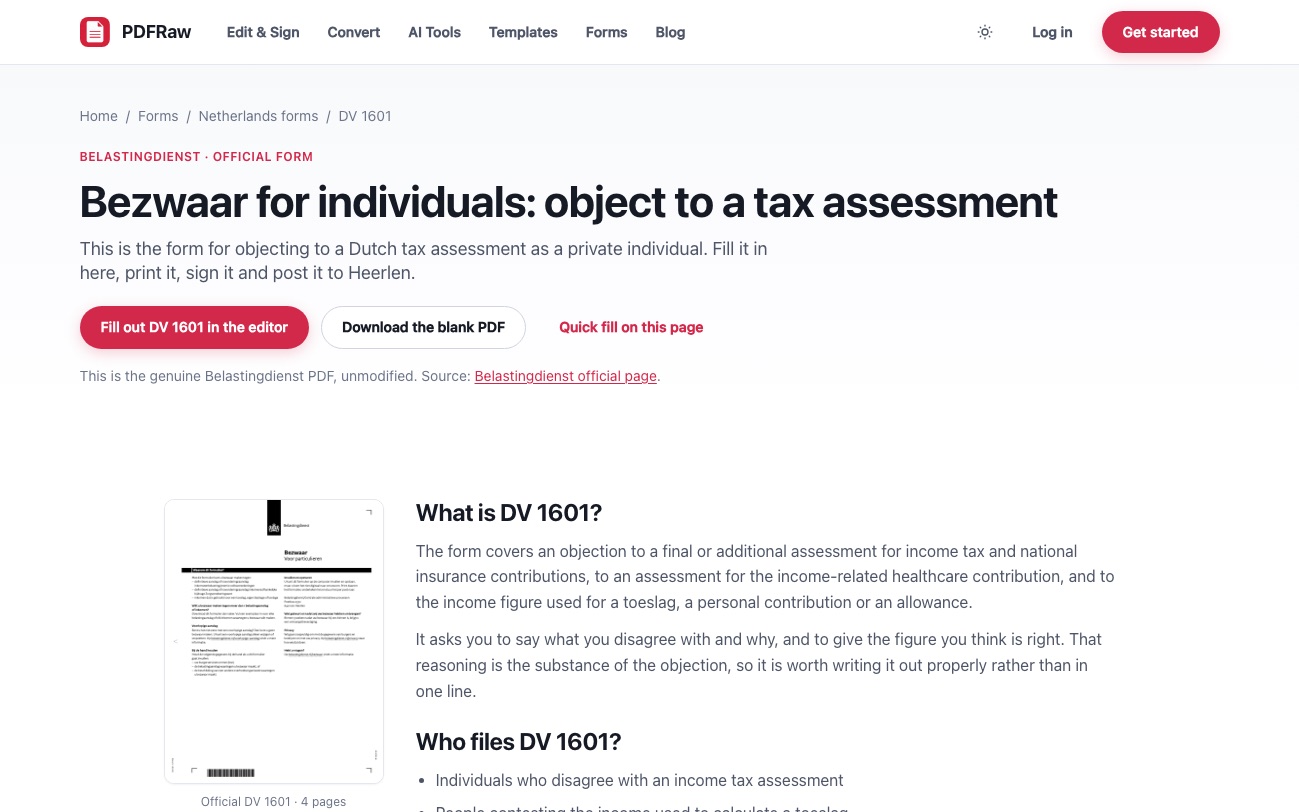
There are two objection forms and they are split by who you are, not by which tax. Individuals use the bezwaar form for particulieren, which covers a final or additional income tax assessment, the income-related healthcare contribution, and the income figure used to calculate a toeslag or an allowance. Businesses use the zakelijk version, which adds corporation tax and turnover tax, including an additional VAT assessment.
The deadline is six weeks from the date printed on the assessment, for both of them. An objection that arrives after that is normally treated as a late request rather than a valid objection, which is a materially weaker position.
Two rules catch people out. A voorlopige aanslag, a provisional assessment, cannot be objected to at all; it is changed or stopped instead, and the private form says so on its face. And one objection covers one assessment: two assessments means two copies of the form, not one letter listing both.
What makes an objection work is the part no form can do for you. Both versions ask what you disagree with, why, and what figure you believe is correct. That reasoning is the substance, and a single line saying the amount is too high is not an argument. You should get an acknowledgement within three weeks of it arriving; if nothing comes, the first thing to check is whether it reached the right address.
If you cannot pay: a plan, or a write-off
A betalingsregeling spreads the debt. The standard term is twelve months, counted from the day the plan is granted rather than from the day you ask, and longer is possible only where the Belastingdienst accepts that there are special circumstances, which it describes as health problems and comparable situations. The form for individuals asks for your income, a partner income where there is one, and your fixed costs, so it can see what is left over, then for the monthly amount you are proposing.
Invorderingsrente carries on running on whatever is outstanding. A plan spreads the payments; it does not freeze the debt.
The business version is the same instrument with a harder edge. It is one form for both a payment plan and a deferral of payment, it asks for the full financial picture of the company, and before granting a plan the Belastingdienst normally wants security: the form asks what you can offer, and a bank guarantee, a mortgage or a pledge are the usual answers. Filing the request does not by itself stop collection action, so the practical advice is to keep talking to the collection office while it is being decided.
When a plan would not be realistic at any monthly figure, the request is kwijtschelding instead: cancel the debt, because income and assets are not enough to settle it. That is assessed against published norms rather than negotiated, which is why the form is so detailed about money. It asks for income and benefits, rent or mortgage, insurance, care costs, savings, a car and any other assets, then asks the same questions again for a partner you live with. Toeslagen debts have their own remission route, so check which of your debts sit on the tax side before filing.
Needing more time to file is a different form
An uitstel request for the income tax return moves the filing date, not the payment date. Belastingrente can still be charged on tax owed, so an extension avoids a late-filing problem and buys nothing on the money.
It has one hard requirement and one odd one. The request has to reach the Belastingdienst before the final filing date of the return, because after that you are simply late and a different conversation starts. And the form states that it must be completed on a computer: a handwritten copy cannot be processed, which is one of the few places where filling a PDF online is not a convenience but the only route. If an adviser with a beconnummer files for you, ask them first, because their own extension scheme usually gives more time than this form does.
A related form is worth knowing about for the opposite reason. If your income swung sharply across three consecutive years, a middeling request averages your box 1 income over those years, and where the swing was large enough that can produce a refund rather than a bill.
When the Belastingdienst is the one running late
The deadlines run in both directions. If Toeslagen has gone past its statutory decision period on an application, an objection or another request, an ingebrekestelling puts it formally in default and gives it two weeks to decide after all.
It is a formal step rather than a complaint, and the distinction matters: a complaint is about how you were treated, this is about a decision that is legally overdue. If the two weeks pass with still no decision, a dwangsom can start to accrue in your favour and the route to an appeal against failure to decide opens up. Cases with the Uitvoeringsorganisatie Herstel Toeslagen go down a different path and have their own form, which the first page of this one flags.
Small things that decide whether any of it lands
Every one of these forms is posted, and most of them are posted to a specific address printed on the form itself rather than to a general Belastingdienst address. Keep the assessment beside you while you fill it in: its date, its number and its amount are asked for on all of them, and the date is what the six weeks runs from.
If money is coming back rather than going out and the account the Belastingdienst has is wrong or closed, the opgaaf rekeningnummer is the paper route to change it, for people who cannot get into Mijn Belastingdienst. Refunds are only paid into an account in your own name, which is a fraud control rather than an administrative preference. And if a toeslag is involved at all, the figure that drives it may be your worldwide income, declared on the opgaaf wereldinkomen.
All of these are in Dutch, including the ones aimed at people who have recently arrived. If that is the wall you are hitting, filling out a Dutch form when you do not read Dutch is the companion to this one, and the whole Dutch catalog sits in one place.
Frequently asked questions
How long do I have to object to a Dutch tax assessment?
Six weeks from the date printed on the assessment, for individuals and businesses alike. An objection that arrives later is normally treated as a late request rather than a valid objection.
Does filing a bezwaar postpone the payment?
No, not automatically. If you need the payment suspended while the objection runs, ask for uitstel van betaling separately. For businesses, the payment plan form covers both a plan and a deferral.
What is the difference between betalingsregeling and kwijtschelding?
A betalingsregeling spreads the debt over time and you still pay all of it, normally within twelve months. Kwijtschelding asks for the debt to be cancelled because your income and assets are not enough to settle it. Ask for remission when a payment plan would not be realistic at any monthly amount.
Can I object to a provisional assessment?
No. A voorlopige aanslag cannot be objected to; it is changed or stopped instead. The objection form for individuals says this directly.
Can I put two assessments on one objection form?
No. The Belastingdienst asks for one objection per assessment, so use a separate copy of the form for each one.
Does an extension to file stop interest running?
No. Belastingrente can still be charged on tax you owe, so an extension protects you from a late-filing problem and nothing else. File as soon as you can even with one granted.